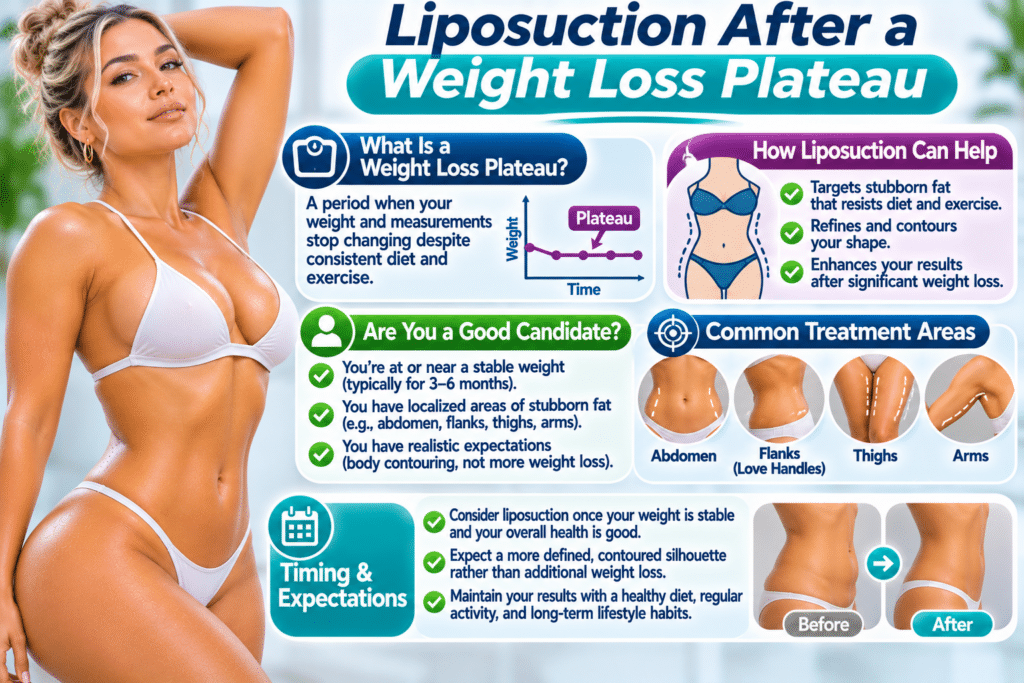
Key Takeaways
- Weight loss plateaus, where your progress stalls despite your best efforts, can be caused by metabolic adaptation, changes in your activity, or simply underestimating your diet. Find probable culprits prior to surgery.
- Liposuction provides localized contouring of fat deposits that are resistant to diet and exercise, not major weight loss. The best candidates are those already close to their ideal weight.
- Full evaluation and timing count. Secure stable weight and good health, record old ways, and wait a few months after plateauing before scheduling the procedure.
- Manage expectations – liposuction shapes the body over time, relies on the skin’s ability to contract and removes a limited amount of fat in any one sitting.
- Recovery involves downtime, compression garments, and aftercare to reduce swelling and support healing.
- Long-term results are contingent upon maintaining healthy habits, monitoring body changes, and selecting a qualified provider to minimize risks and complications.
You can think of liposuction after weight loss plateau as a surgical salvage option for stubborn fat that defies diet and exercise. It focuses on key trouble zones like the stomach, thighs, and arms to enhance your shape. Candidates are typically close to their target weight and in good health. The procedure can be combined with skin tightening or subsequent care to smooth results. The slices below highlight categories, hazards, healing durations, and pragmatic hopes.
Plateaus
Weight loss plateaus are periods during which weight does not drop any more even though effort continues. A plateau is usually considered to be maintaining the same weight for three weeks or more. Plateaus are common and for many come about a year or two after bariatric surgery or medical weight-loss intervention. They arise during non-surgical attempts when early losses decelerate and the body finds a new equilibrium.
Metabolic adaptation accounts for a lot of this deceleration. Once you lose a lot of weight, your body cuts back on resting energy expenditure and alters hormones that regulate hunger and satiety. Regarding plateaus, metabolism shifts to accommodate the smaller body size and reduced calorie needs, so the same diet and activity that worked before may no longer generate a deficit. Following bariatric surgery and medical intervention, this metabolic reset can be particularly pronounced. Plateaus emerge because, over time, tiny differences in daily energy use or consumption accumulate and dull additional loss.
Plateaus mess with more than just scale digits. Frustration, loss of motivation, and lower confidence are typical responses. They may begin to doubt the plan, skip workouts, or loosen food rules, actions that only serve to reinforce the stall. Once you recognize it, a plateau is easy to get beyond. Knowing why it happened deflates blame and directs instead to pragmatic changes.
Common reasons for a plateau include:
- Plateaus — Metabolic adaptation to lower body weight after surgery or after sustained loss.
- Decreases in activity, even modest drops in daily steps.
- Changes in sleep patterns that alter hunger hormones.
- Dehydration or fluid shifts can camouflage real weight change.
- Small increases in portion sizes or frequency of snacks.
- Erratic use of metabolic or appetite medications.
- Stress, which can change eating patterns and activity.
- Plateaus come naturally to non-linear weight loss progress.
How to respond: Start by tracking measurable factors—weight trend, food intake, activity, sleep, and medications—over a few weeks to spot small shifts. Switch calorie needs to current weight rather than past weight. Add or change activity type: mix resistance training to preserve lean mass with higher-intensity intervals to raise short-term energy needs. Better sleep and hydration help regulate appetite and energy. Ask the care team about medication, hormone checks, or adjusting a post-op plan. Behavioral hacks like meal timing and mindful eating help reverse creeping portion drift.
Plateaus are normal and they often indicate a need for recalibration, not failure.
Strategic Intervention
Liposuction is a strategic intervention when conventional wisdom can’t bust a plateau. It targets those stubborn, diet-and-exercise-resistant fat pockets like the abdomen, flanks, inner thighs, or submental region. Knowing the distinction between subcutaneous fat, which is beneath the skin, and visceral fat, which is around internal organs, counts. Liposuction addresses subcutaneous fat and does not impact visceral fat or serve as a substitute for metabolic health interventions.
1. Assessment
Consider your general health and weight stability beforehand. A plateau is temporary if a period of stable weight, perhaps a few months, demonstrates that. Take a medical history, medications, and things that can impact healing like diabetes or smoking.
Pinpoint stubborn fat pockets by physical exam and if applicable, imaging. Target those areas that persist despite calorie swapping and regular exercise. These are the typical areas to contour.
Record present habits and previous methods of weight loss — diets, exercise regimens, and even medications and supplements. This history enables the surgeon and care team to strategize and avoid redoing steps that have already been proven ineffective. Make a list of what you want and prioritize. Practical objectives elucidate what liposuction can and can’t do.
2. Timing
Hold off on surgery until weight is stable. The best timing is at or close to a sustainable goal weight. This increases the alignment of expectation and probable outcome. We typically advise achieving a goal weight before body contouring for best results and minimal risk of complications.
Make sure all the non-surgical stuff was tried and tweaked. Strategic intervention after an early plateau often does the trick, and if those still leave localized fat, then surgical options come into play. Schedule the operation when you can provide sufficient recovery time and aftercare without significant disruption.
3. Expectations
Liposuction is contouring; it’s not weight loss. The maximum safe volume of fat to be removed is based on the patient’s health, body composition, and the judgment of the surgeon. Expect gradual improvement. Swelling masks early results and the final shape shows over months. Skin elasticity plays an important role as well, as skin with decreased elasticity from rapid weight loss, aging, or sun damage can sag in a way that lipo alone can’t remedy. Occasionally, additional skin-tightening or excisional procedures become necessary.
4. Recovery
Usual convalescence is a couple of days’ bed rest and a few weeks of reduced activity. Typical side effects include swelling, bruising, and temporary pain. These generally subside week by week. Compression garments assist with healing and contour the area. Adhere to aftercare diligently to mitigate risks such as subpar wound healing or contour irregularities.
5. Longevity
They have staying power so long as the habits remain healthy. Weight gain negates any contour advantages, so eat sensibly and exercise regularly. Track body changes over time to catch new areas early. Address skin issues upfront to minimize sagging and maintain results.
Body Reshaping
Liposuction can polish body proportions by extracting areas of persistent fat that linger after a weight loss plateau and by aligning remaining contours to the patient’s frame. It is designed to attack those stubborn pockets where diet and exercise fall short, sculpting more natural blending between treated and untreated areas. When fat is eliminated from one region, other areas may appear proportionally more aligned. This can enhance the way clothes fit and the symmetry of your body without a major shift in total body weight.
Typical treatment areas are the abdomen, thighs, arms, flanks (love handles), back, and chin. The abdomen minimizes a stubborn lower belly pouch. Thigh work can sculpt and slim the inner or outer thigh to relieve chafing and define your leg silhouette. Arm liposuction removes the fullness that makes sleeves tight. Flank treatment smooths out the waistline. Each zone has specific goals: define the waist, slim the legs, or create a smoother arm line. Some patients do zone combinations in a single session, while others stage procedures to control operative time and recovery burden.
Before and after scenarios demonstrate how liposuction and adjunct procedures can alter function and appearance. Example A: a patient with 25 kg weight loss retained a lower abdominal roll. Liposuction and abdominoplasty removed excess skin and fat, improving posture and ease of exercise. Example B: another patient had focal thigh fat that persisted. Inner-thigh liposuction reduced rubbing and allowed more comfortable walking and clothing choices. Results vary according to skin quality, age, and the volume of tissue excised.
- Abdomen — Expected contouring: flatter lower belly, better waist definition. This may be paired with abdominoplasty if loose skin is present.
- Thighs — Expected contouring: narrowed inner or outer thighs, reduced chafing. Results vary with skin laxity and may need skin removal in severe cases.
- Arms — Expected contouring: slimmer upper arm silhouette and reduced sleeve tightness. Skin elasticity affects final outcome.
- Flanks/back — Expected contouring: smoother waistline, less bulging above hips, improved back contour when seated and clothed.
- Chin/neck and small areas — Expected contouring: sharper jawline, less fullness under the chin. Often outpatient with quick recovery.
Body-contouring surgeries beyond liposuction address loose skin and larger reshaping needs: abdominoplasty, panniculectomy, breast rejuvenation, buttock lift, and circumferential body lift. These procedures can be staged with recovery in between. Recovery is usually uncomfortable for the first six weeks, with a full recovery taking several months and compression garments being worn for six to eight weeks. Stopping smoking weeks before surgery is typically required. Certain treatments require an overnight stay, while others are same day.
Clinical Hazards
There are clinical hazards to liposuction post weight-loss plateau that patients and clinicians need to consider. The surgery is not without risk, and knowing typical and rare complications aids in establishing reasonable expectations and directing safer decisions.
Create a checklist of risks with descriptions:
- Wound infection is reported in fewer than 3% of inpatient cases and about 1% in outpatient surgeries. Redness, warmth, pain, and drainage are all early signs. If left untreated, cellulitis can advance to sepsis or necrotizing fasciitis, both surgical emergencies requiring immediate intervention and antibiotics.
- Bleeding and hematoma: Small vessel injury from the cannula can cause bleeding under the skin. If large or tense, hematomas may require drainage. Meticulous intraoperative technique and postoperative monitoring mitigate this risk.
- Seroma: Fluid collection can form where fat was removed. It can need multiple needle drainings and compression garments to cure. Seromas can delay recovery and increase the risk of infection.
- Contour deformities: Uneven fat removal leads to lumps or depressions. Prevention is by using smaller cannulas, avoiding superficial suction, employing a crisscrossing pattern, and slight undercorrection to leave room for post-op fat lysis.
- Sensory changes: Temporary numbness or altered skin sensation is common. Nerve fibers in the subcutaneous tissue are stretched or bruised. Sensation typically comes back over weeks to months, though numbness can linger, less so, but it’s possible.
- Fat embolism: Rare but severe. Soon thereafter, fat globules came to be recognized as potential emboli capable of entering the bloodstream and lodging in the lungs or other organs. The fat embolism mortality rate is between 10% and 15%. Quickly identifying respiratory distress and providing intensive care is key.
- Venous thromboembolism (VTE): Deep venous thrombosis and pulmonary embolism occur infrequently. Incidence is low at 0.03%. Pulmonary embolism continues to be the leading cause of post-liposuction death, while overall mortality is approximately 0.01%. The risk is greater with long procedures, combined procedures, and in patients with a previous clotting history.
- Systemic inflammatory response: Liposuction causes a transient rise in interleukin-6 and C-reactive protein. These markers normalize and do not increase the risk for chronic kidney disease or ongoing inflammation.
- Anesthesia-related complications: Local or general anesthesia carries its own set of risks, from allergic reaction to cardiopulmonary events. Review the anesthesia plan with your team.
Selecting a good provider minimizes risks. Board-certified plastic surgeons or trained physicians with high-volume experience, accredited surgical facilities, and clear protocols for infection control and VTE prevention reduce complication rates. Inquire about complication rates, patient selection, and contingency plans.
Pre-op optimization helps too: stop smoking, manage diabetes and obesity, review medications that affect bleeding, and plan staged procedures if large volume liposuction is considered.
Alternative Procedures
Non-surgical and minimally invasive options provide methods to eliminate stubborn fat after a weight-loss plateau without the downtime of surgical liposuction. These procedures utilize cold, heat, radiofrequency, or focused ultrasound to injure fat cells, which the body subsequently clears over a period of weeks to months. They’re most effective for small, localized fat deposits on the abs, hips, thighs, flanks, and chin, with certain machines providing light skin contraction.
CoolSculpting utilizes targeted cooling to crystallize fat cells. Sessions can require 35 to 60 minutes per area. Discomfort is usually low, with a cold or tugging feeling during treatment and mild soreness after. Results come on slowly over six to twelve weeks and often require two or more sessions for a noticeable difference. CoolSculpting is for individuals near their optimal weight who desire subtle contour change without scars.
SculpSure and truSculpt employ laser or radiofrequency heat to damage fat cells. They tend to be short, roughly 25 minutes per area for SculpSure, but larger zones or multiple areas can increase that. Heat can create warmth and a momentary sting during the treatment, with some soreness afterward. Patients don’t see results for weeks, even months, and usually necessitate return trips. Both platforms can address CoolSculpting-like areas and provide mild skin tightening through collagen activation.

Focused ultrasound devices go after deeper fat layers. Sessions range from less than an hour to a couple of hours, based on area. Pain is mild to moderate during energy delivery. A noticeable difference might require two to three months. Exilis and other radiofrequency-based treatments encourage skin tightening as you shed fat, which is useful when loose skin is an issue after weight loss.
Cellulaze tackles cellulite from the inside out, snapping fibrous bands beneath the skin and smoothing the surface. It’s minimally invasive when compared with full surgery and still requires local or light anesthesia. Recovery’s longer than purely non-invasive options, with swelling and bruising that can linger for weeks. It’s selected when cellulite and not bulk fat is the primary concern.
Comparison of effectiveness and recovery: Liposuction removes larger fat volumes in a single session and provides immediate contour change. It needs anesthesia, incisions, and a recovery period of days to weeks. Non-surgical procedures are safer for small, localized fat, have minimal short-term risk, and enable faster resumption of normal activities. They are not as effective for large-volume reduction and require multiple sessions for modest results.
| Procedure type | Typical session length | Recovery time | Best for | Pros | Cons |
|---|---|---|---|---|---|
| CoolSculpting | 35–60 min | Immediate normal activity | Small pockets | No incision, low pain | Gradual results, may need repeats |
| SculpSure/truSculpt | 25–60+ min | Immediate to a few days | Localized fat, mild tightening | Short sessions, skin firming | Multiple treatments, variable pain |
| Focused ultrasound/Exilis | 30–180 min | Immediate to weeks | Deep fat, skin laxity | Non‑invasive, tightens skin | Longer sessions, delayed results |
| Cellulaze | 60–120+ min | Weeks | Cellulite reduction | Targets cellulite bands | Longer recovery, invasive |
Expert Perspectives
Plastic surgeons tend to see liposuction after weight-loss plateau as a sculpting instrument, not a weight-loss tool. Most specialists suggest that patients hold a stable weight for a few months, typically six to twelve, before scheduling surgery. Stable weight helps guarantee that the fat pockets addressed are retentive and that the scheduling produces permanent outcomes. Surgeons say that liposuction works best for localized pockets of fat that do not respond to diet and exercise, like the flanks, inner thighs or submental area.
We pick patients based on healthy, good skin and realistic expectations. Best candidates are those who are at or close to their goal weight, demonstrate minimal skin laxity and are in good general health. Patients with aggressive pre-operative weight loss, such as post-bariatric or pharmaceutical based loss, may have diminished dermal perfusion and decreased tissue tension. This can reduce skin support and vascularity and increase risk for complications. Skin stretching for years can break down collagen and elastin, so even if you remove the fat, it won’t snap back. A history of intense sun exposure similarly damages collagen and elastin and can lessen the likelihood of smooth, taut outcomes.
Best practices involve careful preoperative evaluation and explicit expectations conversations. Surgeons employ physical exams and, if required, imaging to identify fat pockets. They discuss the potential need for adjunct procedures. Liposuction does not tighten loose skin or repair separated abdominal muscles. When there is skin laxity or diastasis, abdominoplasty, also known as a tummy tuck, or a lower body lift are often the go-to options for firm, natural contours. The best advice is to get to goal weight before contouring to sidestep unpredictable results and potential revisions. Patients who have experienced weight fluctuations in the past should be counseled about an increased risk of staged or combined procedures.
Recent tech advances enhance safety and results. Power-assisted, ultrasound-assisted, or laser-assisted liposuction enables more selective extraction of fat with less fatigue for the surgeon. Tumescent techniques reduce blood loss and ease. Improved tools and optimized anesthesia minimize post-operative recovery. These instruments assist in carving with increased precision, they do not alter the physiology of skin retraction. Technology assists technique, not skin tightening.
There was lots of agreement on reasonable expectations and maintaining your lifestyle. It’s all about diet, exercise, and maintaining your weight in the long run. Patients need to view liposuction as the final step to a weight-loss journey, not a replacement for long-term lifestyle change.
Conclusion
Liposuction can help shape areas that stay stubborn after a weight loss plateau. It is most effective on isolated fat bulges and on skin that still has elasticity. Candidates who maintain a stable weight and good health experience the most defined results. There are risks, so choose a board-certified surgeon and inquire about scar locations, recovery period, and expected contour modifications. Pair it with consistent eating and working out for more permanent effects. For those with loose skin or high-volume loss, supplement with a tummy tuck or skin lift. Consult experts to chart a strategy that matches your objectives and lifestyle. If you need help weighing options or locating a qualified surgeon, request a consult today.
Frequently Asked Questions
What is liposuction after a weight loss plateau?
Liposuction after plateau is an invasive body contouring technique used to permanently eliminate pockets of fat that don’t respond to traditional weight loss methods. It goes after the localized areas to sculpt body contours post a massive weight loss.
Who is a good candidate for this procedure?
Ideal candidates have contained their weight for months, have good skin elasticity, and realistic expectations. A consultation with a board-certified plastic surgeon ensures you’re a good candidate and it is safe.
How soon after weight loss can I consider liposuction?
Be sure your weight has plateaued for at least 3 to 6 months. Stable weight enables the surgeon to predict results and minimizes the risk of revision surgery.
What are the main benefits of choosing liposuction post-plateau?
You achieve targeted fat removal, better body contours, and better clothes fit. It can build confidence when diet and exercise no longer shift certain trouble spots.
What risks should I expect?
Typical risks are swelling, bruising, numbness and infection. Serious complications may include contour irregularities or seroma, although they are rare. A good surgeon reduces risk.
How long is recovery and when will I see results?
Most people resume light activity in 1 to 2 weeks. Final results become evident once swelling subsides, generally in 3 to 6 months. Compression garments speed healing and improve results.
Are there non-surgical alternatives to consider?
Yes. Choices consist of spot exercise, diet fine-tuning, and non-invasive options such as cryolipolysis or radiofrequency. These might be less dramatic, but they come with less surgical risk.