Key Takeaways
- Swelling after liposuction typically migrates downward because of gravity and lymphatic flow. Monitoring moving swelling helps differentiate routine healing from issues.
- Anticipate swelling to be worst in the initial week and then abate slowly over weeks to months, with uneven puffiness and a timeline that varies by location and thickness of the area treated.
- Employ compression garments, consistent elevation, and light movement to minimize fluid accumulation and aid skin retraction. Heed your surgical team’s advice carefully.
- Lymphatic drainage massage, cold compresses, proper hydration, and limiting salt and alcohol can help you recover faster and reduce lingering swelling.
- Other variables such as age, skin elasticity, location of fat on the body and lifestyle will determine how quickly swelling dissipates. Track your progress in photos and appreciate the little victories.
- Be vigilant for red flags like severe, progressive, or asymmetric swelling, fever, unusual pain, or signs of infection and get urgent medical attention if these develop.
Swelling descends post-liposuction due to gravity’s effect on fluid and inflammatory components. Swelling shifts over days to weeks as fluid accumulates in dependent areas and tissues redistribute.
Lymphatic drainage and patient activity influence where swelling manifests, with prolonged standing or sitting causing more lower accumulation. Appropriate compression, movement, and follow-up care assist this downward swelling and healing in its efforts to create more even contours of healing.
The Downward Drift
Downward drift of postoperative swelling after liposuction is common as fluids exit the treated site and migrate along gravity and body channels. This transition is healthy for recovery and accounts for puffiness emerging in areas distant to the incision. Anticipate worst swelling during the initial 3 to 7 days, a firm or bloated sensation persisting for several weeks, most noticeable enhancement from weeks 2 to 6, ongoing sculpting from 3 to 6 months, and intermittent minor swelling up to 12 months.
1. Gravity’s Pull
Gravity pulls free fluid and edema out of the surgical site toward lower areas of the body. When a surgeon suctions fat, blood and tumescent fluid mixed with inflammatory fluid can accumulate and then creep downward. Prolonged standing or sitting exacerbates this.
Patients who remain on their feet for hours at a time often observe more swelling around the knees, ankles or lower abdomen by the end of the day. Abdominal liposuction can have swelling settle lower on the belly or into the groin. After thigh work, puffiness tends to make an appearance at the knees or calves.
Follow morning-to-night variations and record where swelling occurs, which distinguishes usual gravitational descent from what requires medical attention. Most activity-related swelling subsides over months, but can re-emerge briefly after a long day or workout.
2. Lymphatic Pathways
The lymph system drains excess fluid from tissues, and its natural flow is to drain fluid toward regional drainage basins lower on the body. Effective lymphatic drainage hastens absorption of excess fluid and reduces swelling sooner. Manual lymphatic drainage massage performed by trained therapists can clear operative edema and relieve pain.
When lymph channels are blocked or slow, swelling lingers and tissue repair is prolonged. Post-operative lymph flow is slow early on. Activity, hydration, and compression garments assist it.
Any persistent or asymmetric swelling should prompt a clinician to rule out lymphedema or local collections.
3. Surgical Trauma
Liposuction damages tissue intentionally. That damage induces swelling and fluid invasion. Tiny blood vessels and lymphatics are ruptured, so fluid accumulates until repair renews those channels.
More extensive or aggressive procedures generate a more inflammatory response and a more pronounced early swelling. Surgeons employing gentle technique and minimizing unnecessary tissue trauma correlate with less extended edema.
Anticipate the majority of reduction in swelling between weeks three and six, with subtle contour settling occurring over three to six months.
4. Fluid Dynamics
Tumescent liposuction necessitates infiltration of anesthetic-laced saline, which grossly volume expands tissues initially. Other fluid not absorbed by cells, along with toxic residue from metabolic functioning, follows gravity and lymph paths, leading to downward drift.
Early swelling is normal and can present as hard bloating for a few weeks. Compression, consistent motion, and hydration assist the body in eliminating this liquid.
Be alert for signs of overload, such as intense pain, bizarre shape changes, or fever, and get treatment if they happen.
Swelling Progression
Swelling after liposuction progression is fairly standard, yet individually variable by patient, technique and fat layer suctioned. Immediate postoperative puffiness represents fluid and micro-collections of blood in the treated planes. This initial swelling helps protect tissues and alerts the body’s repair response.
Anticipate the greatest swelling in the first 24 to 72 hours post-surgery, as the area can feel tight, warm, and uncomfortable. Pain and bruising tend to be at their highest as well, but both generally decrease as the swelling starts to subside.
Swelling is still significant through the first week and begins to level off after the initial peak. During that initial week, the treated area can sometimes feel bumpy or uneven, which is normal as the soft tissue settles and small pockets of fluid move around.
By the end of week two, you should notice a distinct decrease in overall swelling and a subtle contouring of the jawline or contour treated, but this is not the final shape. The majority of the swelling is resolved by four to six weeks; however, the refining process continues.
Anticipate the majority of swelling to resolve within 3-6 months. During this time, the body gradually reabsorbs excess fluid and the tissue beneath the skin reformats. That’s when that final chin or body shape usually settles in.
A little swelling may persist beyond this period, particularly after exercise, heat, or a salty meal. Temporary rebounds of puffiness are a standard reaction as lymphatic flow and local circulation adjust.
The depth of fat removal alters swelling progression. Superficial liposuction, which extracts fat immediately beneath the skin, tends to result in more noticeable skin textural changes and surface firmness during recovery. Thus, swelling may be uneven for a longer period.
Deeper fat can cause more diffuse swelling but occasionally less surface lumpiness. Both varieties need to have the skin retract. Tighter skin will smooth over sooner, while looser skin can take months to conform and sometimes still exhibits residual unevenness.
Uneven swelling, transient numbness or firmness are normal healing phenomena. Compression garments, worn day and night in the beginning, reduce fluid accumulation and promote uniform tissue reattachment.
Gentle massage or lymphatic drainage, as suggested by your surgeon, can accelerate reabsorption. Keep an eye on it and if you experience increased pain, redness or fever, this could be a sign of complications.
Managing The Flow
One of the most important aspects of liposuction recovery is managing postoperative swelling. The remainder of this section dissects practical methods that combine to reduce fluid accumulation, assist tissues to settle, and accelerate the return to normal contours.
Compression
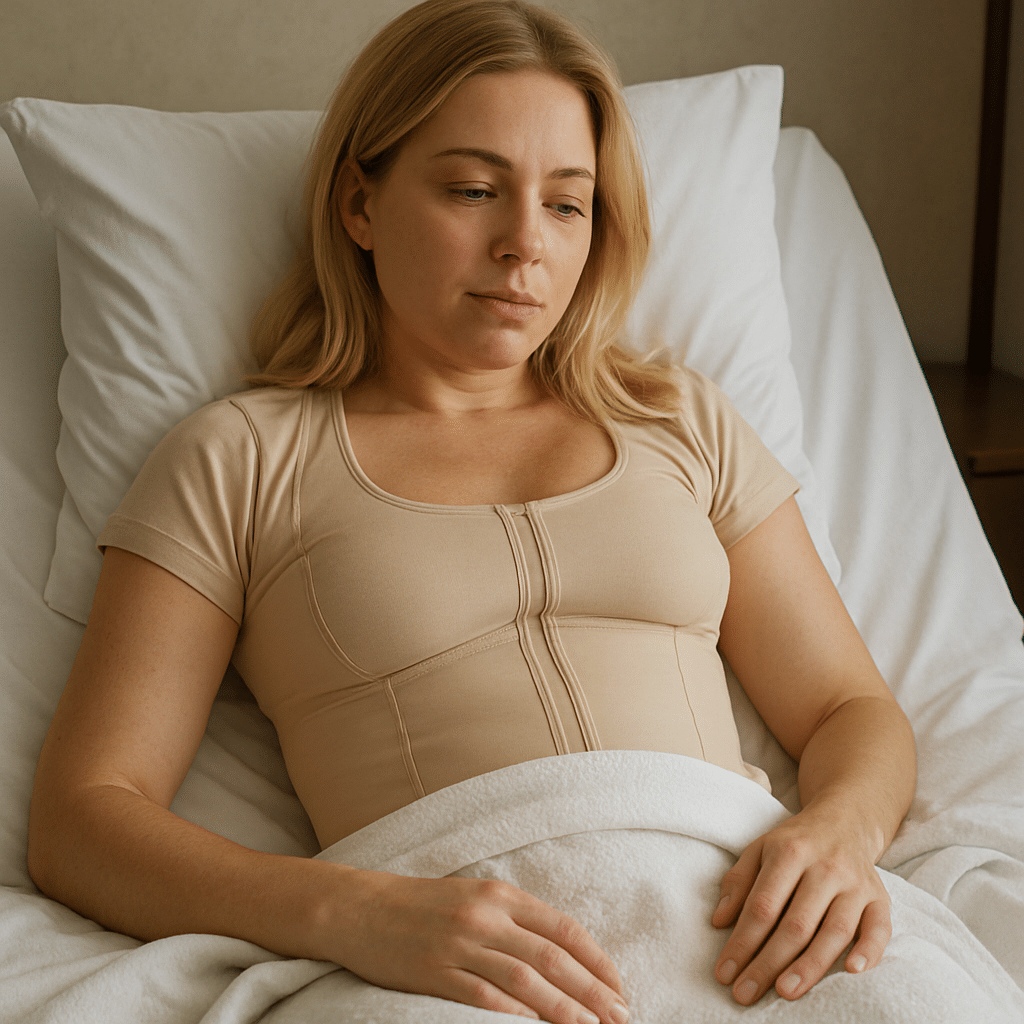
Compression garments or bandages, worn as instructed, provide consistent external support to treated tissue. This assistance combats fluid seeping into dead space, reduces bruising, and facilitates more uniform skin retraction.
Pick a garment that covers the precise treatment zones — abdomen, thighs, arms, or chin — without digging in or hurting. A good bra fits tight but not painfully so. If it hurts, try a different size or a different brand.
Don’t quit compression prematurely. Taking them off too soon usually causes rebound swelling and stretches healing tissues, prolonging your recovery. Most surgeons will advise you to wear continuously for the initial few weeks, tapering off as healing and comfort dictate.
About 70% of swelling typically resolves in the first month, but compression for a longer duration helps control the rest that can linger for months.
Elevation
Elevate swollen extremities above your heart anytime you can to aid in moving the fluid away. Manage The Flow – Prop legs with pillows after thigh or lower-body liposuction and keep your head slightly elevated after submental (chin) work to reduce facial swelling.
Short, frequent elevation sessions during the day are more effective than one long session. No prolonged hours of standing or sitting without elevation during the initial healing period.
Intermittent position changes and scheduled elevation minimize surface puffiness and promote lymphatic flow. Pairing elevation with brief cold compresses can enhance the effect.
Hydration
- Consume a minimum of 2 to 3 liters of plain water daily, scaled for body size and climate.
- Begin a basic hydration journal. Mark bottles or use an app for reminders.
- Avoid salt and processed foods for a few weeks before and after surgery to minimize fluid retention.
- No booze and no extra caffeinated drinks in early recovery. They can influence hydration and swelling.
Adequate hydration promotes tissue repair and minimizes water retention.
Movement
Start slow movement and short walks early post-op to activate your lymphatic system and avoid rigidity. Light activity, such as walking a few times a day, promotes fluid clearance without stress on the tissues.
Put off heavy lifting and intense cardio until your surgeon gives you the green light, as exertion can worsen swelling. Add basic ROM exercises to assist circulation and oedema.

We’ve found the best results come from balancing rest with frequent, mild activity. Apply cold compresses for 15 to 20 minutes at a time in the early postop period to augment these measures and shield skin integrity.
Location Matters
Liposuction swelling has a pattern that is largely location dependent. Different sites, such as thighs, abdomen, flanks, arms, and chin, have different tissue types, blood flow, and lymphatic drainage. They alter how much swelling is visible, its duration, and migration.
For instance, the chin and neck tend to surface smooth quickly but maintain deep toughness longer, whereas the abdomen can remain puffy for weeks as a result of thicker subcutaneous tissue and increased fluid accumulation. Areas with loose skin or where a large quantity of fat is extracted tend to swell more and for longer.
Skin that doesn’t shrink well leaves room beneath where fluid pools, so the site appears more voluminous and can feel tense. For example, patients having multiple sites treated at a time may notice one area settles faster than another. Surface swelling may ease quickly on the arms but hang on the thighs, creating early asymmetry that can be distressing but is normal.
Gravity alters the expanding path. Swelling from surgeries in higher locations can track down to lower parts of the body due to fluid migration. After abdominal liposuction, some fluid migrates into the pubic region and upper thighs. After flank work, swelling can track toward the hips and groin.
Gravity explains why swelling fluctuates through the day. Standing and walking let gravity pull fluid down, making the area look worse by evening than in the morning after rest. Surface swelling and deep tissue changes subside on different schedules. Surface puffiness tends to fall away first, and the skin appears less swollen within days to a few weeks.
Deeper tissue, including fibrotic bands and retained fluid within muscle fascia, requires a prolonged period to soften and smooth; in some cases, this may take several months. That layered recovery leads to uneven appearance: one side may look smooth while the other stays firm, or one treated zone may look dramatically larger than an adjacent zone until deeper tissues settle.
Swelling can shift and mold itself around, so watching and anticipating has to occur. Compression garments can assist in preventing fluid shift by supporting tissues and balancing pressure. MLD and light movement can accelerate surface resolution but do less for deep tightness.
A straightforward table of average timelines—chin (surface 1 to 3 weeks, deep 2 to 6 months), abdomen (surface 2 to 6 weeks, deep 3 to 6 or more months), thighs (surface 2 to 8 weeks, deep 3 to 9 months)—helps establish realistic expectations. Keep track on a daily basis and remember that morning to evening fluctuations are normal, and report extreme asymmetry or severe pain to a clinician.
Your Unique Recovery
Each liposuction recovery is influenced by a combination of biological and pragmatic factors. Age, skin thickness, health, and the extent of the procedure establish the stage for how swelling manifests and migrates. Genetics, previous surgeries, and where fat is stored on the body all affect both the degree and duration of swelling.
Track progress closely and honor small victories. Even comparable surgeries can yield distinct timelines and results.
Body’s Blueprint
Skin elasticity and tissue texture dictate how fluid flows and how fast contours sharpen. Thicker or less elastic skin retains swelling longer. Thin, flexible skin is usually quicker to respond.
Your underlying health conditions are important. Obesity, poor circulation, or conditions that cause fluid retention will delay healing and increase puffiness. The larger the area treated or the more areas worked on, the more swelling to anticipate.
Your body’s genetic blueprint will determine both short-term swelling and final shape. Bottom line: Document baseline photos to watch slow change. Photos provide concrete evidence when you thought healing was slow. Photograph yourself in the same light, position, and clothes to compare.
Lifestyle Impact
Good nutrition and not smoking accelerate tissue repair and reduce inflammation. A low-sodium diet for at least two weeks post-op aids in fluid retention. Restrict alcohol and processed foods because they exacerbate inflammation and fluid retention.
Wearing compression garments continually controls swelling, supports tissues, and assists skin in conforming to new shapes. Adhere to garment wear instructions on hours and compression level. Improper use can delay recovery instead of assisting it.
Light activity, such as short walks, enhances circulation and mobilizes lymph fluid. Stress management, including sleep, breath work, and light stretching, fuels immune response and tissue repair. Stabilize weight post-surgery to safeguard results. Significant fluctuations can regrow asymmetry or cause recalcitrant swelling.
Mental Aspect
All of that puffiness and bruising is visible and impacts your mood and self-perception. Anticipate moderate pain, bruising, and inflammation to crest between three and seven days and subside across the following three weeks. Being aware of this common curve aids in establishing more realistic expectations.
Set concrete, time-based expectations: noticeable reduction often occurs within one to three months, with final results at six to twelve months. Be patient and kind to yourself. Rejoice in little victories such as decreased hardness or defined edges.
Your mindset shapes your aftercare. Adhering to post-operative instructions, such as garments, diet, activity, and medications, has a direct tie to smoother healing and better results. Mental care is just as crucial as physical care in having a successful liposuction experience.
When To Worry
Post-liposuction, some downward swelling is to be expected as fluid obeys gravity and tissues shift. Yet some patterns and symptoms indicate complications requiring prompt attention. Use the checklist below to monitor for red flags and respond promptly when something deviates from a normal healing trajectory.
Checklist of warning signs and what they may mean
- Sudden increase in swelling after initial improvement. If swelling goes down for a few days and then spikes again, this is a red flag. It can mean bleeding under the skin (hematoma) or a growing fluid pocket (seroma) that needs evaluation and possibly drainage.
- Localized redness and warmth or increasing pain in one spot points to infection a lot. A small, spreading red patch around an incision or a hot, tender spot should trigger same-day communication with your surgeon or primary care provider.
- Foul-smelling sewage or pus from incisions. Any malodorous or discolored fluid leaking from wounds is not normal. This requires prompt medical evaluation and probable antibiotic and wound care.
- A hard, painful lump that is fluctuant. A palpable, tense lump can be a seroma or hematoma. Seromas can be dealt with by aspiration. Hematomas occasionally require surgical evacuation. Don’t attempt to squeeze or lance it yourself at home.
- Obvious asymmetry with one side being significantly more swollen. Uneven swelling beyond the expected minor differences can signify localized bleeding, trapped fluid, or uneven tissue injury that requires clinical review.
- High fever, chills or just feeling really bad. Systemic manifestations such as fever can be suggestive of an infection that has extended beyond the skin. These need immediate treatment and sometimes IV antibiotics or more intensive observation.
- Shortness of breath, chest pain, or a sudden sharp calf pain. These are emergency symptoms of a potential blood clot or PE. If you have these symptoms, go to an emergency department right away.
- Swelling that does not improve or gradually worsens over weeks. Normal post-op swelling usually lessens steadily over days and weeks. Persistent or worsening swelling, especially with increasing pain or redness, should be evaluated to rule out infection, fluid collections, or other complications.
For each warning sign, mark its timing, severity, and any improvement after activity or removal of clothing. Take photos to share with your clinician and maintain a temperature and symptom log.
Early contact with your surgeon can keep small issues from becoming serious. If you can’t reach your surgeon and symptoms fit the emergency items above, go to urgent care or an emergency department.
Conclusion
Why swelling moves downward after liposuction Tissues retain fluid postoperatively. That fluid takes the path of least resistance. Gravity draws fluid to lower areas. Activity and ordinary daily posture direct the flow. The kind of liposuction, the area treated, and the healing process alter the pattern. Most people experience consistent, gradual improvement over weeks to months. Be on the lookout for infection, sudden pain, or deep redness. Test light activity, apply any suggested compression, and obey your surgeon’s care plan. If concerns persist or new symptoms arise, give your surgeon a call. Book a follow-up if swelling persists past anticipated timelines.
Frequently Asked Questions
Why does swelling move downward after liposuction?
Swelling follows gravity and lymphatic drainage. That’s just the way swelling behaves. It accumulates in dependent locations and essentially sinks downward with time. This is a routine part of healing for many patients.
How long does downward swelling last after liposuction?
Most of this downward swelling starts subsiding between 4 to 12 weeks. Small residual fluid can take 6 to 12 months to fully resolve. Timelines are different per procedure and per patient.
Can downward swelling be reduced faster?
Yes. Wearing compression garments, gentle lymphatic massage, light movement, and staying hydrated all help reduce swelling faster. Adhere to your surgeon’s post-operative plan.
When is downward swelling a sign of a problem?
Seek medical advice if swelling is sudden, painful, red, warm, or accompanied by fever. Those symptoms can indicate infection or a blood clot and require prompt evaluation.
Does the liposuction area shape change because of downward swelling?
Temporary shape changes can develop as fluid shifts downward. Final contours are generally apparent once the majority of swelling subsides, which tends to be a few months post-op.
Is lymphatic drainage therapy safe for reducing downward swelling?
When provided by a trained therapist and commissioned by your surgeon, MLD is safe and effective for diminishing post-op swelling. Surgery clearance first.
Can activity affect how swelling moves after surgery?
Yes. Standing or sitting for long periods can aggravate downward pooling. Short walks and position changes facilitate lymph flow and minimize dependent swelling.