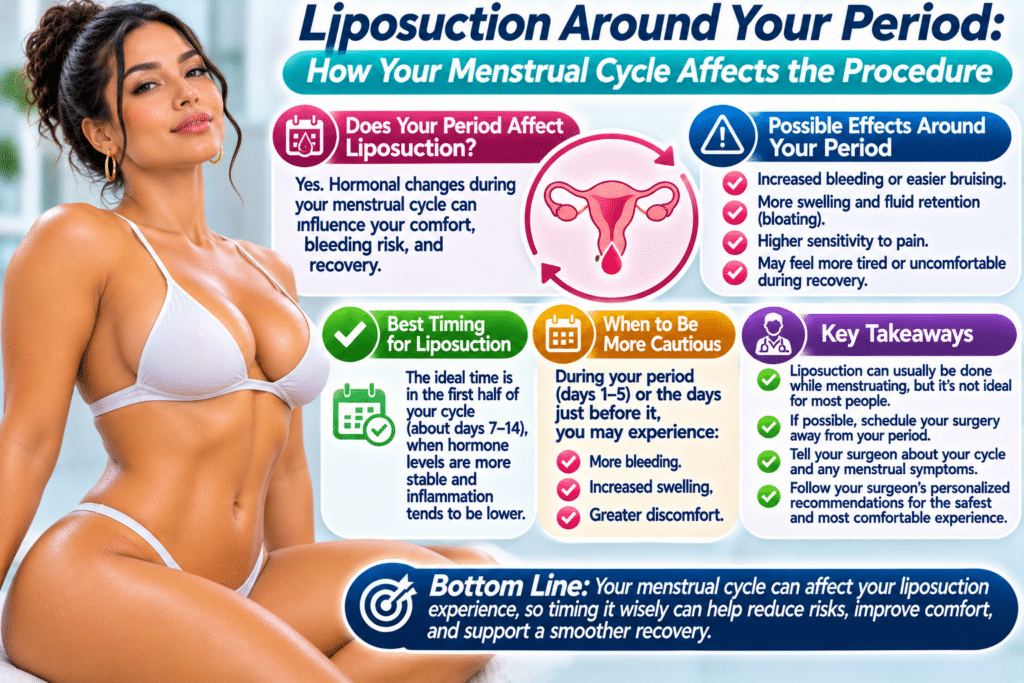
Key Takeaways
- Hormones impact liposuction results and recovery as estrogen and progesterone shift fluid balance, inflammation, and tissue response throughout the cycle. Track your cycle so you can plan timing with your surgical team.
- The early to mid-follicular window, roughly days 6–13, is generally the most favorable for scheduling liposuction as swelling tends to be less and healing more stable during this time. Keep this window in mind when scheduling surgery.
- Steer clear of active menstruation and the luteal phase when you can, as bleeding risk, fluid retention, pain sensitivity, and wound healing all tend to be elevated at these times.
- Take a menstrual calendar, record symptoms such as bloating or breast tenderness, and communicate this information to your surgeon to customize timing and preoperative measurements.
- Keep an eye out for particular risk indicators — a weird bleeding history, large fluid shifts, or an increased pain sensitivity — and ask for preoperative tests or a change in plan as necessary.
- Tailor postoperative care to cycle phase by expecting increased swelling or bruising during high-progesterone periods and addressing them with targeted interventions like cold compresses, elevation, gentle massage, and planned follow-ups.
Liposuction and when you’re on your period deals with scheduling body-shaping surgery around someone’s cycle to minimize pain and bleeding. Surgeons tend to favor the follicular phase, around days 6 to 14 of a standard 28-day cycle, when hormones and swelling are more predictable. Patient comfort, pain management and clotting elements play into timing considerations. We go deep on preoperative planning, hormone considerations and practical tips for selecting the optimal day.
Hormonal Influence
Hormonal changes throughout the menstrual cycle alter tissue condition, fluid balance and immune signals in ways pertinent to liposuction timing and recovery. Knowing when estrogen and progesterone take over allows clinicians to anticipate swelling, bruising, healing rate and longer-term fat retention. Here is a table of main hormonal effects on liposuction results.
| Hormone / Phase | Primary effects on tissues | Impact on liposuction outcomes |
|---|---|---|
| Estrogen (follicular, peak pre-ovulation) | Lowers proinflammatory cytokines, recruits fibroblasts, augments collagen cross-linking | Less bruising/swelling, stronger wound tensile strength, ~30% better fat retention reported |
| Progesterone (luteal phase) | Promotes water retention, increases vascular permeability, may delay repair processes | More edema and bloating, higher pain sensitivity, slower wound healing, risk of increased bruising |
| Menstruation / Progesterone withdrawal | Endometrial breakdown, local inflammatory repair | Potential for altered coagulation and healing dynamics; timing may affect comfort and bleeding |
| General surgical stress (post-op cortisol) | Elevated cortisol for up to 7 days | Blunted immune response and altered wound healing irrespective of cycle phase |
Estrogen Shifts
Estrogen’s up in the follicular phase and stabilizes blood vessels and keeps tissue more elastic, which can make liposuction planes easier to work with. Estrogen minimizes proinflammatory cytokines and accelerates resolution of acute inflammation, so early healing is purer. This hormone introduces fibroblast activity that optimizes collagen cross-linking, resulting in greater wound tensile strength and reduced risk for premature wound dehiscence. Proof connects elevated estrogen to approximately 30% increased fat retention following transfers, by extension, ‘optimal’ estrogen windows should help shape post-lipo results. Track cycles with ovulation tests or apps to locate the pre-ovulatory estrogen surge, slotting in that window minimizes bruising and short-term edema.
Progesterone Spikes
Progesterone peaks in the luteal phase and introduces water retention, bloating, and increased vascular permeability. Patients frequently experience increased swelling and pain during this time. Progesterone can delay certain types of tissue recovery and can increase post-operative pain and bruising sensitivity. Progesterone withdrawal at menstruation initiates local breakdown and repair, which can interface with wound healing and affect bleeding or scab formation. With these impacts in mind, skip elective liposuction during peak luteal days if possible. The surgical surge in cortisol for approximately a week compounds immune shifts and can modulate how progesterone impacts recovery.
Optimal Procedure Scheduling
When scheduling liposuction around menstrual cycles, it can affect bleeding, swelling, and healing. Scheduling surgery during periods of relative hormonal stability can minimize complications and discomfort. Here are actionable tips to assist patients and surgical teams schedule the procedure with transparent motivations and illustrations.
1. Follicular Window
Early to mid-follicular phase (days 6–13) is usually the best time for liposuction. Hormone levels, both estrogen and progesterone, are low but rising, which appears to restrict fluid retention and acute inflammatory reactions. Research and clinical experience demonstrate that patients operated on within this window tend to have less post-operative edema, less bruising and faster wound healing. For instance, someone who gets surgery on day 8 experiences less swelling than a similar case done in the luteal phase. Tissue healing and immune response are more stable, reducing infection risk and facilitating predictable recovery. Use this stage when you can for body contouring, particularly if your patient requires minimal downtime before heading back to work or a trip.
2. Ovulation Phase
Ovulation (day 14) again delivers a peak of estrogen and increased tissue perfusion. More vascularity can translate into a minor but immediate surge in intraoperative bleeding and postoperative bruising. For this reason, some surgeons avoid operating 24 to 48 hours from ovulation. If scheduling near ovulation is unavoidable, weigh pros and cons. Faster wound healing with higher estradiol may be a benefit, but the bleeding risk is the trade-off. They can track ovulation signals—clear cervical mucus, temperature changes, ovulation tests—to ensure there are no surprise shifts pushing the scheduled date into this window.
3. Luteal Delay
The luteal phase (days 15–28) is characterized by elevated progesterone and typical symptoms such as bloating and breast tenderness. Progesterone likes to hold onto fluid, which can enhance swelling and prolong healing. Data connects postovulatory timing to increased wound dehiscence and hypertrophic scarring. If your planned date lands in this phase, consider rescheduling until the next follicular window. Keep symptoms like bloating or localized tenderness as easy, convenient reminders that you’re in your luteal phase.
4. Active Menstruation
Don’t get surgery on an active cycle – you’ll bleed more and feel like crap because of the cramping and fatigue. Menstrual bleeding could affect hemodynamic stability in vulnerable patients and potentially interfere with anesthetic management. Bleeding to stop wait, even a few days, can make a measurable difference to operative and recovery conditions. For planning help, use this quick checklist to build a menstrual cycle calendar:
- Note the first day of bleeding as day 1.
- Follow your cycle length for three months to establish an average.
- Predict follicular and luteal windows based on that average.
- Add planned leave or holidays for recovery time.
- Mark breastfeeding and postpone surgery a few months after weaning if necessary.
Surgical Safety Risks
When is too early to schedule a liposuction procedure in relation to your menstrual cycle. Surgical safety risks. Hormonal shifts alter fluid balance, clotting, pain sensitivity and immune response. Knowing the cycle phase allows for nuanced preoperative planning, complication reduction, and realistic recovery expectations.
Fluid Retention
Hormone-driven fluid shifts commonly occur in the luteal phase and just before menses, causing mild to moderate edema that can raise postoperative swelling. Increased fluid can blur immediate surgical contours and make it hard to judge final results for weeks. Track changes by weighing the patient daily in the week before surgery and measuring limb or abdominal circumference at fixed points. A rise of more than 1 to 2 percent body weight or noticeable circumference increase may indicate significant retention. Schedule procedures when these measures are lowest, often in the follicular phase for many people. Explain that compression garments must be worn for several weeks after liposuction. Wearing them while hot or humid can add discomfort, so season and fluid status both matter when planning. For example, a patient with preoperative premenstrual swelling who has surgery during high-retention days may need longer compression use and may see delayed deflation of edema.
Bleeding Tendency
Active menstruation and particular phases of the hormonal cycle can put you at a higher risk to bleed during liposuction. Menstruation itself is a time when some patients have heavier bleeding. Operating while on heavy flow may marginally increase intraoperative blood loss and complicate field visualization. Take a menstruation history to screen for heavy or irregular menses, and inquire about anticoagulants, herbals, and bleeding disorders. Make sure clotting factors are stable. If history is suggestive of increased bleeding, get coag studies preoperatively including platelet count and INR. Patients should never use tampons on the day of surgery; pads are safer and easier to manage. If preoperative work-up or history suggests a coagulopathy, either reschedule or modify technique and hemostasis measures.
Pain Sensitivity
Pain thresholds shift across the cycle, frequently declining in the luteal phase when PMS symptoms are at their highest. They experience increased tenderness and lower tolerance which can exacerbate perceived postoperative pain and make early mobilization more difficult. Try to schedule when pain sensitivity is probably higher, typically the mid-follicular phase, for a smoother immediate recovery. Employ pain tracking apps or basic daily logs to chart personal pain profiles for a minimum of two cycles before surgery. Better timing can reduce opioids, improve sleep, and accelerate return to task. Keep in mind that anesthesia recovery and requiring help after hours-long procedures are still crucial planning considerations independent of cycle phase.
Recovery Timeline Impact
When we liposuction during the menstrual phase can alter not only the timeline but the quality of recovery. Hormonal changes affect fluid balance, vascular permeability, pain and tissue repair. Awareness of your current phase impacts your recovery timeline. Employ cycle phase as a planning tool and as a benchmark when recording recovery milestones.
Tissue Swelling
Swelling is typically more pronounced when the surgery takes place during mid-luteal and late-luteal phases, when progesterone is elevated and the body holds on to fluid. This may result in more apparent edema within the initial 48 to 72 hours and a more decelerated early decrease. Intermittent cold compresses for the initial 48 hours, regular elevation when feasible, and surgeon-recommended compression garments decrease fluid accumulation and accelerate comfort. Soft, daily movement, such as short walks and easy mobility, aids lymphatic flow and reduces clotting risk while protecting treated areas.
Track swelling daily with a simple log: note girth measurements, subjective tightness, and pain level each morning. Take photos of the treated areas from stationary angles every 2 to 3 days for six weeks and compare. Schedule a follow-up visit at one week and again at 4 to 6 weeks so the surgeon can monitor for lingering edema or early signs of seroma that require intervention.
Bruise Clearance
Bruise resolution tends to run faster in the follicular phase, when estrogen is comparatively higher and vascular responses can support faster capillary repair. Bruising should reach its maximum within the first few days following liposuction before evolving to yellow-green hues over 7 to 14 days as hemoglobin degrades. After the initial 48 to 72 hour period, gentle lymphatic massage can speed clearance, as can approved topical agents such as arnica or vitamin K creams where recommended by the surgeon.
Compare bruise patterns if you’ve had procedures in different cycle phases to help guide future scheduling. Photograph bruises every day for the first two weeks, then weekly until it completely clears. This pictorial documentation allows both the patient and clinician to observe if recovery progresses as expected or requires additional attention.
Practical timeline notes: most patients feel better within one week. Desk work usually restarts in 5 to 10 days. Underlying jobs might require more than 2 weeks. Hard labor frequently needs more than 4 weeks. Initial results are seen at 1 month, but significant swelling continues. Contour stabilizes at 3 to 6 months, with recovery lasting up to 6 months and scar maturation taking up to 12 months. Minor asymmetries at 2 months typically resolve by 6 months.
Clinical Perspective
Surgeons, for example, cite tangible connections between the timing of the menstrual cycle and the results of cosmetic surgery, so tracking cycle phase informs scheduling. The period splits into four stages: menstrual, follicular, ovulatory, and luteal. Each stage has unique hormone environments that impact bleeding, swelling, pain sensitivity, and tissue healing. For liposuction, these physiological shifts alter immediate post-op symptoms like bruising and edema and longer term phenomena like fat graft retention and scar quality.

Clinical experience and limited published evidence favor scheduling liposuction during the early to mid follicular phase, post menses and prior to ovulation. Patients in this window have lower baseline edema and less vascular reactivity, both of which can decrease intraoperative bleeding and early postoperative swelling. Surgeons seeking to optimize fat survival consider estrogen effects: estradiol boosts fat metabolism and, in fat grafting contexts, is associated with roughly 30% greater fat retention after transfer. This information is useful when combining liposuction with grafting for contour or reconstruction.
Surgeons are known to shun the postovulatory luteal phase for elective operations when possible. The luteal phase is less predictable, ranging from 11 to 17 days, so timing has to be tracked for each woman rather than by calendar days. Research shows increased incidences of wound dehiscence and hypertrophic scar formation if surgery is performed during the postovulatory days 15 to 28. At the same time, estradiol aids wound tensile strength in the weeks post-surgery by recruiting fibroblasts and promoting collagen cross-linking, so timing that balances these effects is a clinical judgment rather than a hard rule.
Practical surgeon preferences reflect the balance of these findings. For large-area liposuction, many teams request discontinuing combined hormonal contraception for about one month before surgery to normalize coagulation and reduce thrombotic risk while still weighing contraception benefits against bleeding risks. Preoperative counseling includes discussing expected variations in bruising and swelling across the cycle and planning analgesia and compression garment timing to match peak edema windows.
Planning ahead, on an individual basis, makes it all safer and more satisfying. Clinicians should take a focused menstrual history: typical cycle length, date of last period, contraceptive use, and known hormone therapies. By keeping detailed records of cycle timing, intraoperative observations, and postoperative outcomes, providers can fine-tune their scheduling and care for future patients. For example, a patient with a 28-day cycle may be booked for day 6 to 10, while one with a 35-day cycle needs later follicular dates. Recording outcomes proves those decisions.
Practical Planning Tips
Timing liposuction with your cycle can soften recovery and decrease discomfort. Follow your cycle to discover reliable low-hormone windows and schedule practical planning steps that align with work, home, and weather demands.
Make your own menstrual calendar when planning surgery dates. Record the first day of bleeding, flow intensity, cramps, and mood shifts for a few cycles. Highlight the early to mid follicular phase, which is approximately days 5 to 10 for most, as a favored window due to lower estrogen and progesterone and frequently gentler tissue reaction. Include work and travel obligations, social engagements, and anticipated heavy-flow days so you steer clear of surgery when bleeding is at its peak. Take a simple paper calendar or app that gives you a 3 to 6 month view. If your cycle is irregular, keep a symptom log and possibly try a brief trial of cycle regulation with your clinician before setting a date.
Pose direct queries to your surgeon regarding timing and recuperation. Make sure to verify with the surgeon if he or she has a preference for a particular phase of the cycle and why. Inquire about changes in bleeding risk, bruising, and hormone-related pain control. Query recommended downtime: opt for a plan that allows unplugging from work for the first 2 to 3 days. Expect to take 1 to 2 weeks off total, with the option to return to light duties after about a week if you follow post-op rules. Verify if they require pre-op labs or stopping certain medications and how the team approaches contraception, menstrual suppression, or unexpected bleeding on surgery day.
Have a supply and comfort checklist for each cycle phase. For pre-op follicular-phase surgery, pack loose clothing, a few compression garments, mild pain meds approved by your surgeon, and sanitary supplies in case bleeding occurs. For periovulatory or luteal phases, include extra heat packs for cramp relief, anti-nausea options, and a trusted support person for the first 48 hours. For heavier flow phases, add super absorbency pads, disposable underwear, and mattress protection. Through all stages, have a reusable water bottle to stay hydrated, electrolyte drinks as necessary, and convenient meals for as long as 2 weeks. Number one, keep yourself steadily hydrated; it keeps your blood volume stable and minimizes the thicker secretions that bog down healing.
Weigh the benefits and drawbacks of surgery in each menstrual phase. Early to mid follicular: pro — lower hormones, less swelling; con — some still have cramps. Ovulatory: pro — energy may be higher; con — transient hormonal spikes can increase bleeding and sensitivity. Luteal: pro — some predictability for those who feel steady then; con — higher progesterone can mean more bloating, bruising, and discomfort. Menstrual bleeding phase: pro — none notable; con — increased practical challenges with pads and comfort. Think cooler seasons to help wear compression and keep comfortable.
Conclusion
Liposuction near your period has an effect on bleeding, pain and recovery for some individuals. Schedule liposuction mid-cycle or just after your period to decrease the potential for bleeding and alleviate cramping. Make sure to inform your surgeon of your cycle and any birth control or blood thinners. Anticipate a touch more swelling and pain if surgery falls during heavy flow. Follow symptoms for two cycles to identify a pattern. Schedule rest, very light meals, and gentle movement for week one. Apply a cold pack and wear loose clothes to remain calm. Discuss with your care team about any screenings or medications that reduce risk. Schedule a follow-up and report any abnormal bleeding or fever. Find out more from your surgeon and schedule at a time that your body and life can accommodate.
Frequently Asked Questions
Will my menstrual cycle affect liposuction safety?
Menstrual bleeding alone does not make liposuction unsafe. Surgeons usually proceed if you are healthy. Inform your surgeon about heavy periods, bleeding disorders or blood-thinning medications before surgery.
Is there a best time in my cycle to schedule liposuction?
Most surgeons suggest timing it outside of heavy-flow days. The follicular phase, after your period and before ovulation, often harbors less bloating and cramping, which can help ease your comfort and recovery.
Does my period increase surgical bleeding during liposuction?
Regular periods do not make liposuction cause bleeding much more than usual. Excessive bleeding conditions or use of anti-coagulants can increase risk and require preoperative screening.
Will pain or swelling be worse if I have surgery during my period?
Hormones can increase pain sensitivity and fluid retention. For some patients, scheduling it outside of the premenstrual week can help decrease perceived pain and swelling.
Should I change medications related to my cycle before liposuction?
Inform your surgeon of any hormones, birth control pills, and blood thinners. Don’t discontinue any prescribed medications before consulting with your doctor. Your surgeon or anesthetist will suggest safe changes.
Can liposuction affect my menstrual cycle afterward?
Liposuction will not alter cycle regularity. Early surgery stress or medication can cause short term alterations. If cycles do not normalize within two months, reach out to your care provider.
What should I tell my surgeon about my menstrual history?
Give information on cycle length, heavy bleeding, clotting disorders, and use of medications or hormonal therapies. This assists your surgical team in evaluating bleeding risk and scheduling safe timing and care.